
Needle Fear: The Invisible Barrier to Vaccination and Healthcare Access
Introduction:
Trypanophobia—commonly known as needle phobia—is more than just discomfort around injections. It is a recognized psychological condition that can trigger intense physiological and emotional responses, including anxiety, dizziness, and even fainting due to a vasovagal reflex. This often-overlooked issue represents a significant and growing barrier to vaccination and healthcare access worldwide. [1]
Additionally, it is also important to distinguish between needle fear and needle phobia. Needle fear involves anxiety and avoidance of procedures involving injections, while needle phobia is a diagnosable psychiatric disorder characterized by extreme, disproportionate fear. In severe cases, it can lead to serious complications such as respiratory distress or syncope, making patients particularly difficult to manage without proper clinical understanding and training. [2]
Impact of needle fear:
The public health impact of needle fear is substantial.
- Avoidance of vaccination: Delay or refuse vaccines, such as the influenza vaccine. Up to 16% of adults may delay or refuse influenza vaccination due to needle fear [3]
- Vaccine hesitancy and treatment avoidance: Fear of needles remains a global barrier to initiating and adhering to medical treatments [4]
- Negative behavioral impact: Painful or distressing injection experiences reinforce anxiety and avoidance across a patient’s lifetime [5]
- Intergenerational influence: Fear and negative perceptions of vaccination can be passed down, affecting future healthcare decisions [5]
- Strain on healthcare systems: Lower vaccination rates contribute to increased disease burden, morbidity, and healthcare costs [5]
Further, the prevalence of needle fear and phobia highlights the scale of the issue. Estimates suggest that around 10% of the population was affected as early as 1995, with more recent studies indicating a range between 3.5% and 20%. A systematic review and meta-analysis found that needle fear affects approximately 16% of adults, rising to 20–30% in young adults, 20–50% in adolescents, and over 50% in children. The condition is also more common in females and tends to decrease with age. [3]
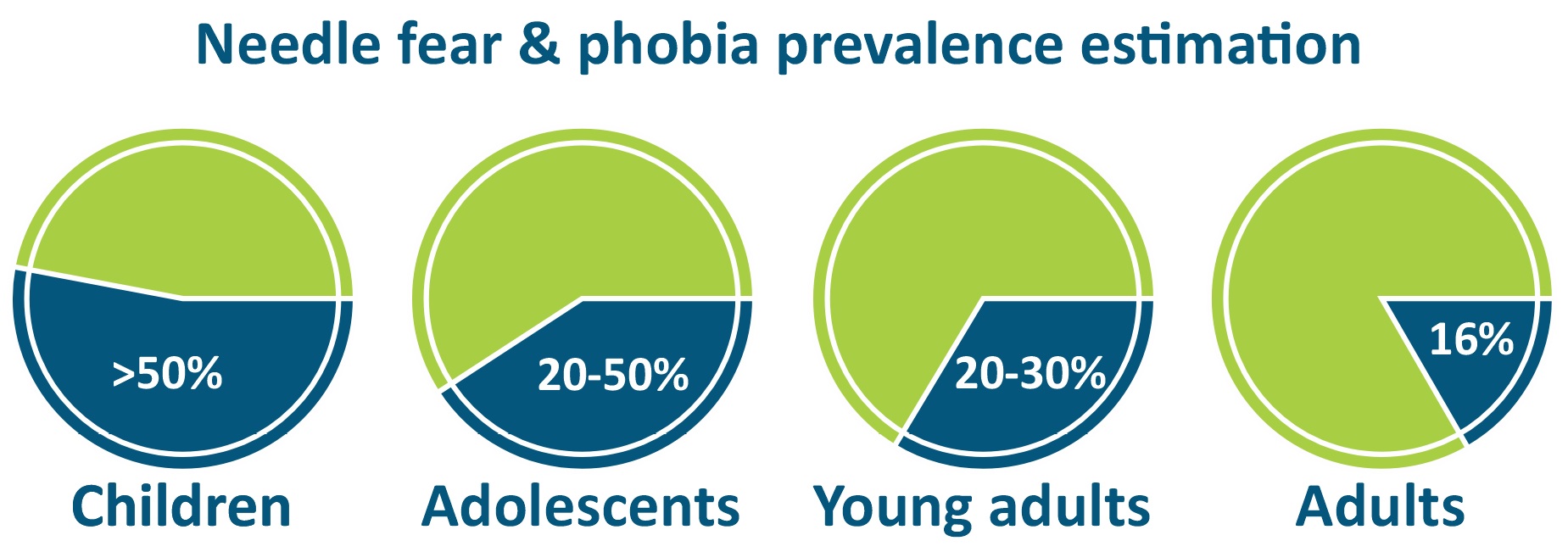
Therefore, addressing needle fear is not just a matter of patient comfort—it is a critical step toward improving global immunization coverage, public health outcomes, and healthcare accessibility.[1]
Why Injection Anxiety Happens
1. Psychological Factors
Fear of needles is often shaped by past negative experiences, learned behavior, and anxiety. Even the anticipation of an injection can trigger [6]:
- Panic and stress
- Hyperventilation
- Vasovagal fainting
These responses can lead to the avoidance of essential procedures across healthcare settings.
2. Physiological Factors
The body’s reaction to injections is linked to how the skin and nerves perceive pain [7]:
- Intramuscular (IM) and subcutaneous (SC) injections penetrate deeper tissue, often causing more pain
- The stimulation of muscle and nerve endings increases discomfort and reinforces fear
- Intradermal injections, delivered just beneath the skin with finer needles, are generally less painful and better tolerated [8]
Needle fear can trigger a vasovagal reflex, where heart rate and blood pressure drop suddenly, leading to dizziness or fainting. This is a physiological reaction, not just psychological, and can be triggered by the sight or anticipation of a needle. [9,10]
Beyond Vaccines
Further, needle fear affects multiple areas of healthcare, including chronic disease management, diagnostics, oncology, and aesthetic treatments. Addressing injection pain and anxiety is key to improving patient experience, compliance, and health outcomes.
The Intradermal Advantage: A Smarter Approach to Delivery
The skin is not just a barrier—it is a highly active immune powerhouse. The intradermal (ID) delivery route targets the dermal layer of the skin, which is rich in antigen-presenting cells, offering a more efficient approach to vaccine and drug delivery.
Key Benefits of Intradermal Delivery [11,12]
- Dose-sparing potential: Achieve strong immune responses with lower doses, improving supply efficiency
- Enhanced immune activation: High concentration of dendritic cells enables effective antigen presentation
- Targeted delivery: Direct access to immune-rich skin layers improves response and consistency
- Reduced pain potential: Shallower delivery with finer needles can improve patient comfort
However, traditional ID injection with a Mantoux technique is technically challenging, requires significant training, and is often associated with variability and discomfort.
Our solution, VAX-ID is a medical device designed to harness the benefits of intradermal injection while directly addressing the causes of needle phobia [13].
How VAX-ID Makes a Difference:
| Traditional Needle Fear Trigger | VAX-ID Solution | Scientific Rationale |
| Needle Length & Visibility | Ultra-Short Micro-Needle | A needle barely visible to the user targets only the dermis, avoiding deeper pain-sensitive structures. |
| Pain & Discomfort | Minimized Pain Perception | Studies show that ID injections with micro-needles are consistently rated as less painful than standard IM injections [14]. |
| Fear of Technique | Reliable Delivery | The device ensures consistent, shallow delivery at the correct depth and angle. |
Therefore, by reducing both the visual trigger (needle visibility) and the nociceptive stimulus (pain perception), VAX-ID directly targets the two primary drivers of needle-related anxiety. This dual-action approach has the potential to improve patient compliance, particularly in populations with chronic treatment needs.
Conclusion:
In conclusion, Trypanophobia is a significant yet often overlooked barrier to vaccination, medical procedures, and healthcare access, with a well-established neurophysiological basis. Addressing it requires evidence-based, patient-centric solutions that reduce pain, anxiety, and procedural complexity.
Innovative technologies like VAX-ID® support this shift by enabling more comfortable, efficient, and reliable intradermal delivery, helping to minimize fear-related responses and improve patient experience. By enhancing treatment adherence, vaccination uptake, and resource efficiency, such solutions contribute to more effective and sustainable healthcare systems.
References:
- https://www.verywellmind.com/trypanophobia-2671700
- American Psychiatric Association. The Diagnostic and Statistical Manual of Mental Disorders: DSM 5. American Psychiatric Association. 2013.
- McLenon J, 2019, PMID: 30109720
- Alsbrooks K, 2022, PMID: 36409734
- Taddio A,2022, PMID: 36283899
- McMurtry CM, 2020. PMID: 32673376.
- Koenitz L, 2024, PMID: 39349073.
- Are some vaccines more painful than others? – Health Academy
- Jenkins K , 2014, PMID: 24574504
- McMurtry C , 2015, PMID: 26352920
- Schnyder J, 2020, PMID: 32898704
- Joyce J, 2020, PMID: 31071375
- VAX-ID
- Gill H, 2008, PMID: 18716497